Skip to content

Deal flow for emerging managers · Fund I / II

Nothing rots in your inbox.

Praxis reads every pitch that reaches you, scores it against your thesis, queues the decision, and — with your approval — sends the reply and updates your CRM. Every step recorded, so you can show anyone exactly why.

Works on top of Gmail, Notion, Attio and Slack. Nothing leaves the building without you.

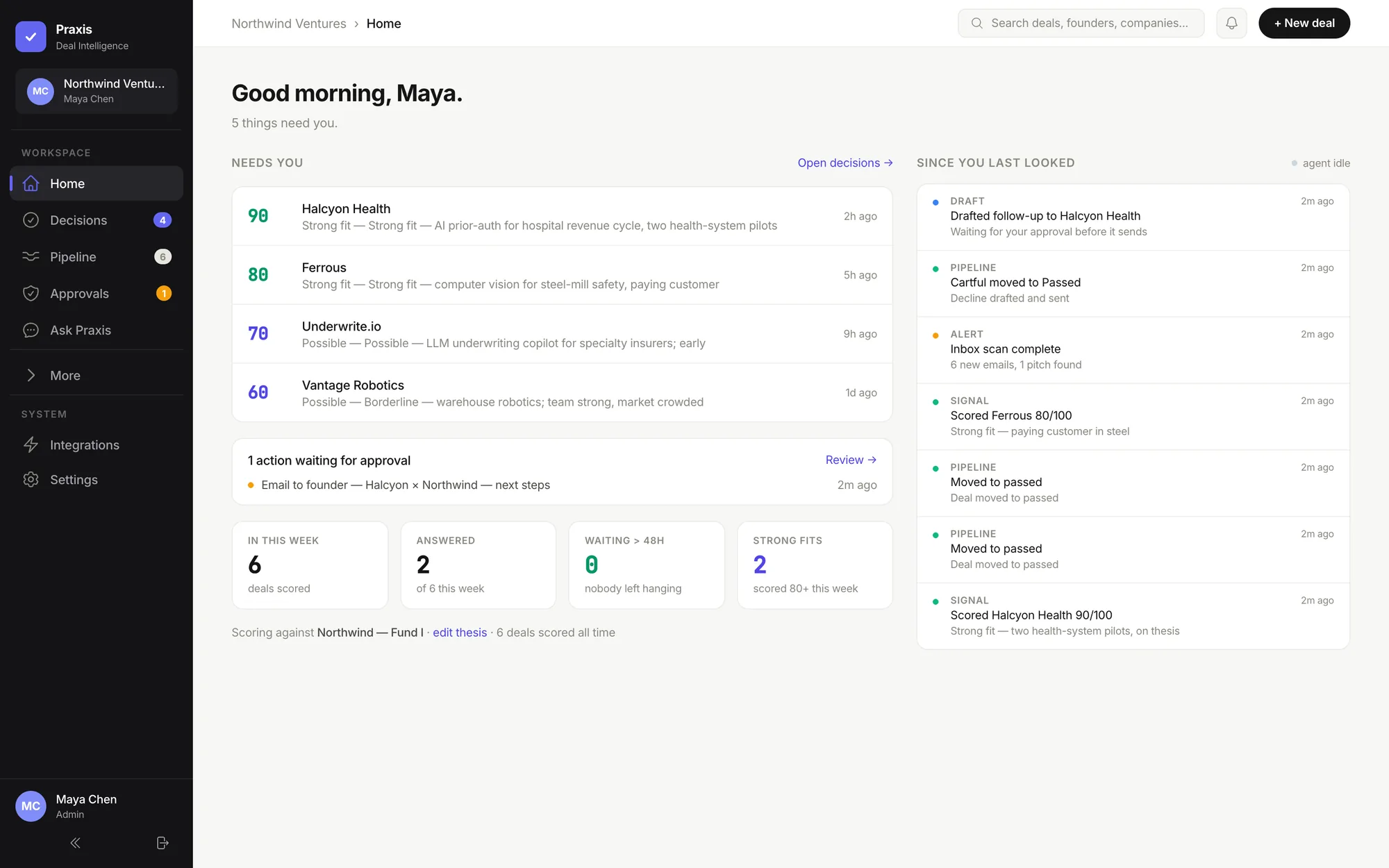
Praxis home screen: a Needs-you list of scored deals, an action waiting for approval, and the agent's feed since you last looked

Home — what needs you, and what the agent did overnight. Fund and companies shown are illustrative.

The problem

Deal flow doesn't fail loudly. It rots quietly.

A one-to-five-person fund sees a few hundred pitches a year. Reading them isn't the hard part — most take five minutes to triage. The hard part is everything around the reading, and it's where reputations are made and lost.

The inbox is the pipeline.

Decks arrive by email, warm intro, Notion, a forwarded thread. Some get read tomorrow, some never. Founders wait, then tell other founders you didn't answer.

So: everything that reaches you is found, scored and queued — and you're told when anyone has waited more than 48 hours.

Monday's no is Friday's maybe.

Screening depends on who's reading, how tired they are, and what came in before. There's no record of why a deal was passed, so the same debate happens twice.

So: every deal is scored against the thesis you wrote, the same way every time, with the reasoning attached.

The boring 20% never happens.

The decline. The "send us the data room". The Attio update. The Slack note. It's not hard, it's just never the most urgent thing — so it slips.

So: the reply is drafted, the CRM note is written, the stage moves. You approve; it does the rest.

"How do you screen?" deserves a better answer.

LPs and co-investors ask. "We read every deck" is true and unconvincing. Process is what you can show, not what you say.

So: a decision log — how each deal arrived, what it scored, which model, what you decided, who, when. Exportable.

Who it's for

Built for the fund that is also the ops team.

Praxis is for you if

  • You're a Fund I or II — one to five people, roughly $10M–$50M
  • Most of your deal flow is inbound: email, intros, your website
  • You have a thesis you can write down and want applied consistently
  • You already live in Gmail, Notion, Attio or Slack and don't want another CRM
  • You'll answer for your process — to partners, founders, LPs

Probably not, if

  • You need a sourcing engine that finds companies for you (Praxis works on what reaches you)
  • You want a CRM — Praxis writes to yours, it doesn't replace it
  • You have a platform team and an Affinity contract; you're past this problem
  • You want an AI that decides for you — Praxis leaves the decision to you, on purpose

What changes

Three things you can hold us to.

Not statistics — commitments. Each one is enforced by the product, not promised by us.

48h

No inbound waits longer without you being told. The home screen counts them; the number should be zero.

1 way

Every deal is scored against the same written thesis, by the same rubric — and every score records the model and prompt version that produced it.

100%

Every decision and every action the agent takes is recorded with who, when and why — and nothing goes to a founder without a partner's approval.

How it works

One loop. Four moments.

A pitch is a decision waiting to be made. Praxis handles everything around the decision and leaves the decision to you.

01 — Arrives

Wherever it lands

Gmail, a Notion database, an Attio record, or the public intake link you put on your site. No forwarding rules, no CSV.

02 — Scored

Against your thesis

Six dimensions and a draft memo. Numbers the deck claims are kept apart from numbers that were verified — and conflicts are flagged.

03 — Decided

By you, in seconds

A queue built for one question: pass or follow up? Keyboard-first on the desk, thumb-first between meetings.

04 — Followed through

With your approval

The decline or follow-up is drafted and waits for a partner. Approved, it sends, posts to Slack, notes Attio, moves the stage.

Decisions

Decide from wherever you are.

Score, verdict, and the two actions that matter. Every decision persists, moves the deal, and is recorded with who made it and when.

  • Strong fits, borderline and passes, one keystroke apart
  • The founder's reply drafted for you — sent only when you say so
  • Nobody waits more than 48 hours without you knowing
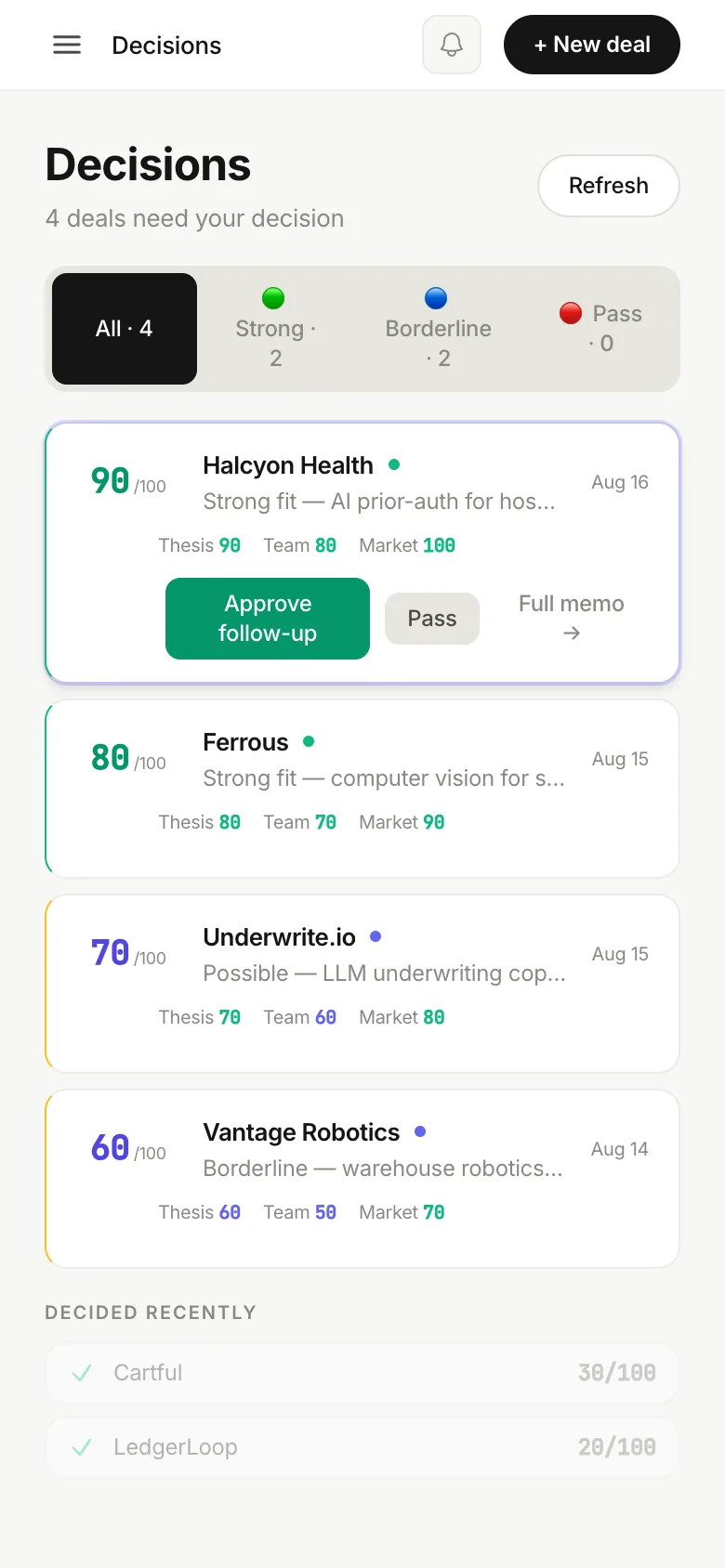
Praxis Decisions queue on a phone: four scored deals with pass and follow-up actions

Approvals

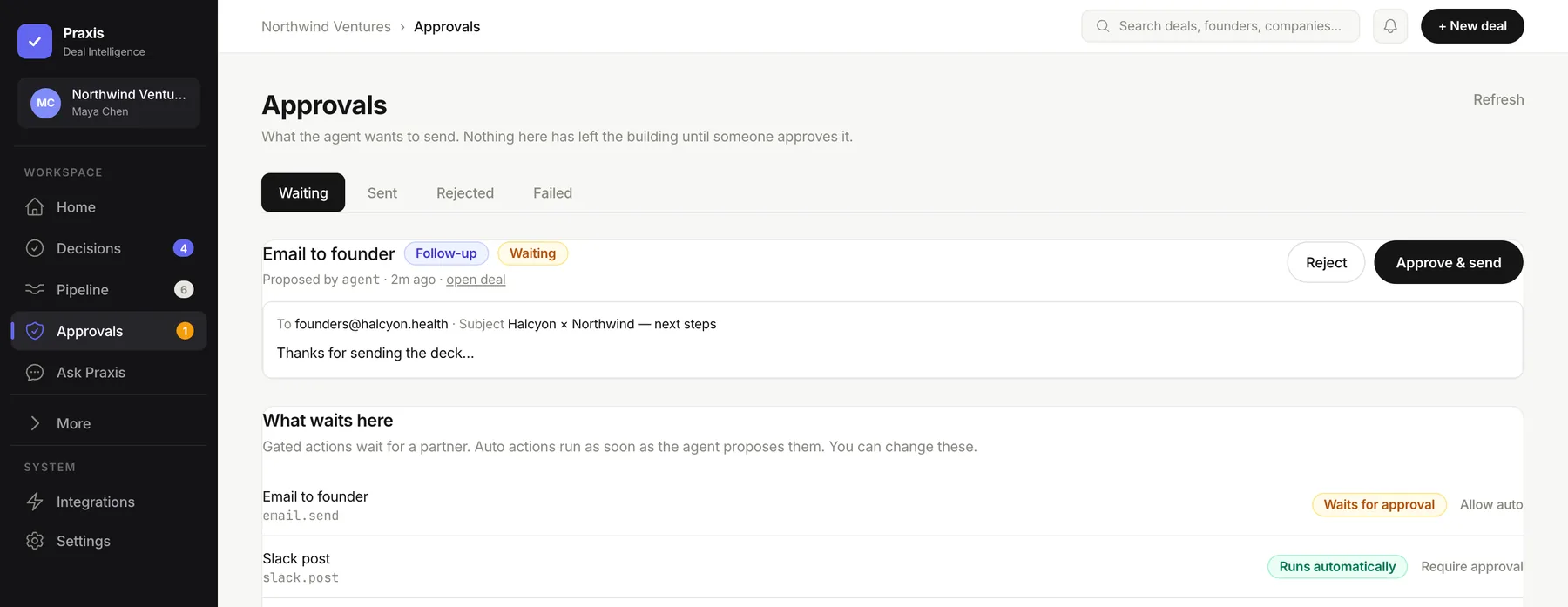
Nothing leaves the building without you.

Outbound actions the agent wants to take — an email to a founder, a Slack post, a CRM update — wait here. You set which run automatically and which need a partner.

  • Founder emails wait for approval by default
  • Slack, Attio and stage changes can run on their own
  • Every approval, rejection and send is in the audit trail
Praxis Approvals screen: an email to a founder waiting for approval, and the autonomy policy for each action type

Why it's different

Built to be trusted, not just fast.

An AI that screens deals is only useful if you can defend what it did — to a partner, a founder, or an LP.

Provenance

Every score shows its work

Which model, which prompt version, which figures came from the deck versus a verified source. Change the thesis and you can see which scores were made under which one.

Lineage & audit

Every action, attributable

Score → document → source → connector → workspace. Every mutation records who did it and why, in the same transaction — including what the agent did on its own.

Your workspace

Roles the API enforces

Admin, partner, analyst, viewer — enforced server-side, not hidden in the UI. Each fund's mailbox, tokens and Slack are its own. Sign in with your fund's Google Workspace.

Pricing

Priced for a fund of one to five.

Not the enterprise stack. Enough for a Fund I to run its inbox properly.

Solo GP
$99 / month

One partner, one inbox.

  • 1 seat
  • Gmail + public intake link
  • Scoring, memos, decision queue
  • Approvals for founder email
  • Full audit trail
Get early access
Team
$299 / month

Up to five people, one thesis to defend.

  • Up to 5 seats with roles
  • Everything in Solo GP
  • Notion, Attio and Slack
  • Attio write-back and stage sync
  • Ask Praxis over your own data
Get early access
Fund
$999 / month

Multiple theses, more hands, your own tooling.

  • Unlimited seats
  • Everything in Team
  • MCP server and API access
  • Multiple theses per workspace
  • Priority support
Talk to us

Early access is free while we validate scoring with the first funds. No card. Prices are what you'll pay when we charge — we'll tell you before we do.

Questions a GP asks

Straight answers.

Does it email founders on its own?
No. Founder emails are drafted and wait for a partner's approval by default. Slack posts, CRM notes and stage changes can run automatically if you allow it — you set the policy per action type, and every send is in the audit trail.
What does it read, and where does the data live?
Only what you connect: the mailbox, Notion database or Attio workspace you authorise, and decks uploaded or submitted through your intake link. Everything is scoped to your workspace — your tokens, your Slack, your deals. Roles (admin, partner, analyst, viewer) are enforced by the API. You can export your decision log any time.
Which AI model scores the deals?
A frontier model via a fallback chain; the point is that every score records exactly which model and which prompt version produced it, so a score from June and a score from October are comparable — or visibly not. Numbers a deck claims are kept separate from numbers that were verified.
Will it replace Attio, Affinity or Notion?
No. Praxis owns the scoring and the decision queue; your CRM owns contacts and stages. Praxis writes scores and notes back to Attio and reads deals from Notion. If you already run a large platform team on Affinity, you're likely past the problem Praxis solves.
How is scoring validated?
Against real decks with known outcomes, fund by fund, during early access — that's why it's free right now. You'll agree or disagree with each score in the product; that feedback is what we tune on. We won't charge until you've seen it be right about your own deals.
What does early access cost, and what happens next?
Nothing during validation. When we start charging, it's the pricing above, and you'll hear from us before it happens. No card now, no lock-in: your data exports as CSV.

Founders

Pitching a fund on Praxis?

Submit your deck directly. It's scored the same way an email would be, and the fund sees it in minutes — with your name attached, not lost in a thread.

Early access

Run your inbox properly.

We're onboarding a small group of Fund I/II managers to validate scoring against real decks. Tell us where to reach you.